
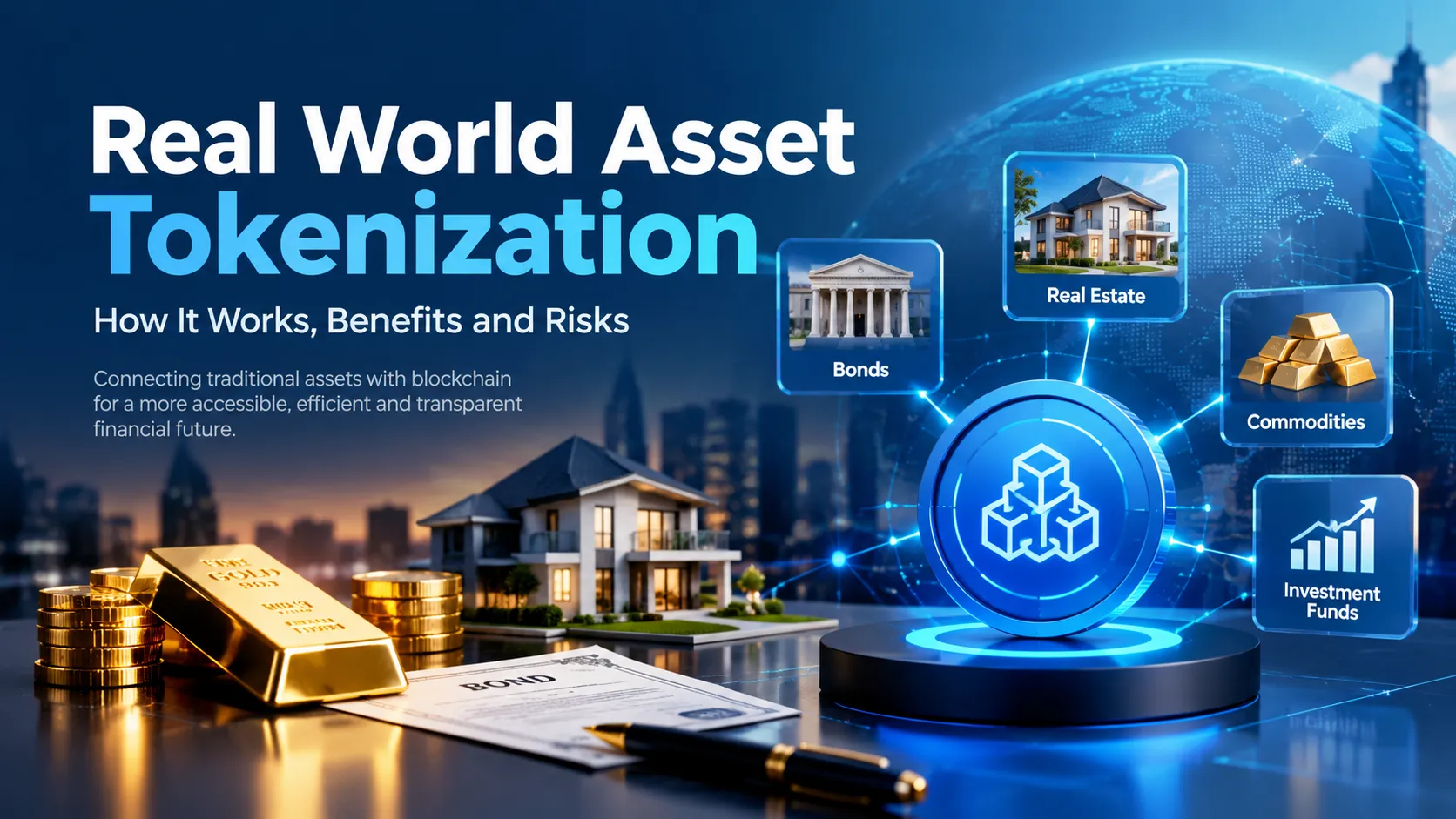
Real world asset tokenization is changing how financial institutions, businesses, and technology companies explore digital ownership. By representing rights to traditional assets through blockchain-based tokens, this approach connects conventional financial markets with digital infrastructure.
Assets that may be represented through tokenization include government bonds, real estate interests, investment funds, commodities, and certain financial securities. Instead of relying exclusively on traditional recordkeeping systems, some tokenization models use distributed ledger technology to record ownership or facilitate transfers.
However, real world asset tokenization is not simply about turning physical objects into cryptocurrency. The legal structure behind a token, the rights granted to its holder, and the way the underlying asset is managed are essential to understanding its actual value.
For investors researching emerging financial technology, the most important questions are straightforward: How does tokenization work? What advantages can it offer? And what risks should be evaluated before purchasing a tokenized asset?
This guide explains these questions, explores practical examples, and outlines the considerations that matter when evaluating tokenized investments.
What Is Real World Asset Tokenization?
Real world asset tokenization, often abbreviated as RWA tokenization, is the process of creating digital tokens that represent ownership interests, financial claims, or other rights associated with an asset.
The process commonly uses blockchain or another form of distributed ledger technology (DLT). These systems maintain records of transactions and can support programmable rules for transferring or managing digital assets.
For example, a financial institution could issue digital tokens representing interests in a government bond fund. Depending on the legal structure, each token might represent a defined claim against the issuer, an interest held through a custodian, or another contractual entitlement.
The important distinction is that a token does not automatically establish direct legal ownership of the underlying asset. Its meaning depends on the issuing arrangement, applicable law, custody structure, and contractual rights.
The US Securities and Exchange Commission has explained that tokenized securities can follow different models, including issuer-sponsored securities and products issued by third parties. These models can provide different rights and expose holders to different risks.
This distinction makes legal documentation just as important as the blockchain technology supporting the token.
How Does Real World Asset Tokenization Work?
Although individual projects use different structures, the tokenization process generally involves several stages.
1. Selecting and Verifying the Asset
The process begins by identifying the asset or financial interest to be represented digitally. This could involve a bond, an investment fund, a property interest, or another eligible asset.
The responsible parties must establish what the asset is, who owns or controls it, and whether it can legally be represented or transferred through the proposed structure.
For physical assets, additional verification may be necessary to confirm existence, valuation, custody, and ownership records.
2. Establishing the Legal Structure
Before issuing tokens, the issuer determines the rights that token holders will receive.
These rights may include an ownership interest, a contractual claim, rights to specified cash flows, or exposure to changes in an asset’s value.
Legal documentation should explain how ownership is recorded, what happens if the issuer becomes insolvent, how transfers are handled, and whether token holders can redeem or sell their holdings.
This stage is critical because blockchain records alone cannot resolve every legal dispute involving an underlying asset.
3. Issuing Digital Tokens
Once the structure is established, the issuer creates tokens using a blockchain or another distributed ledger.
A smart contract may define how tokens are issued, transferred, restricted, or redeemed. For regulated financial products, the system may also incorporate eligibility checks, identity verification, and transfer restrictions.
The technology can automate certain administrative tasks, but it does not eliminate the need for proper governance, legal compliance, or oversight.
4. Managing Ownership and Transfers
After issuance, eligible users may acquire, hold, or transfer the tokens through supported platforms.
Depending on the arrangement, ownership records may be maintained directly on the blockchain, through an intermediary, or through a combination of digital and conventional records.
Some systems support automated settlement and transaction tracking. Others still depend on custodians, transfer agents, banks, or other service providers.
5. Handling Income, Redemption, and Asset Changes
The final stage concerns the ongoing management of the underlying asset.
For example, a tokenized bond product may distribute interest according to its terms, while a tokenized fund may follow a specified redemption process.
Smart contracts can automate parts of these operations when the necessary data and infrastructure are available. However, payments, valuations, corporate actions, and legal enforcement may still depend on off-chain institutions.
Real World Asset Tokenization Examples
Understanding the use cases helps explain why tokenization attracts attention from traditional finance and blockchain businesses.
Tokenized Government Bonds
Government bonds are among the assets that can be represented through tokenization. A tokenized bond product may use digital infrastructure to record holdings, process transfers, or coordinate settlement.
Potential advantages include streamlined administration and more programmable transaction processes.
Nevertheless, investors should determine whether they hold the bond itself, an interest through a custodian, a fund interest, or a separate contractual claim. These structures are not interchangeable.
Real Estate Tokenization
Real estate tokenization may represent interests in a property-owning company, a fund, or another legal arrangement associated with real estate.
For example, a project might divide eligible investment interests into smaller units, allowing investors to participate with less capital than would typically be required to purchase an entire property.
However, owning a property-related token does not necessarily mean owning a corresponding fraction of the property’s legal title.
Property valuation, maintenance expenses, taxes, tenant issues, transfer restrictions, and the legal structure of the investment can all affect the outcome.
Tokenized Money Market Funds
Certain investment funds can issue or record interests using distributed ledger technology.
A tokenized money market fund may provide digital access to an investment product that holds eligible short-term financial instruments. Depending on the arrangement, the token may represent a fund interest recorded through blockchain-based infrastructure.
Investors should still review the fund’s objectives, fees, eligibility rules, redemption terms, and applicable protections. Tokenization does not remove the investment risks associated with the fund’s underlying holdings.
Tokenized Commodities
Commodities such as gold may also be represented by digital tokens.
In a properly structured product, the token may represent a claim to allocated metal, a contractual redemption right, or another form of exposure to the commodity.
The differences matter. Investors should verify whether the physical asset exists, who holds it, how reserves are audited, and whether redemption is available under clearly defined conditions.
Tokenized Private Credit
Some tokenization projects represent interests in private credit arrangements or pools of loans.
Digital infrastructure may help organize records, administer transfers, and coordinate certain payments.
However, private credit can involve borrower defaults, limited liquidity, valuation uncertainty, and complex recovery procedures. The existence of a blockchain token does not make an underlying loan safer or guarantee repayment.
Key Benefits of Real World Asset Tokenization
Tokenization offers several potential benefits, although their effectiveness depends on the asset, platform, legal structure, and level of adoption.
1. Fractional Ownership
Some tokenized investment structures allow an eligible asset or investment interest to be divided into smaller units.
This may lower the initial capital required to access certain opportunities. However, minimum investments, eligibility restrictions, and transaction costs may still apply.
2. More Efficient Recordkeeping
Distributed ledgers can help participating institutions coordinate transaction records and reduce some reconciliation work.
Where systems are properly integrated, this may simplify parts of the ownership and transfer process.
The actual efficiency gains depend on how well the blockchain infrastructure connects with existing financial systems.
3. Potentially Faster Settlement
Traditional transactions may involve several intermediaries and separate settlement processes.
Tokenization can support more automated settlement arrangements, potentially reducing delays in eligible transactions. However, settlement speed also depends on payment infrastructure, compliance checks, and the rules governing the underlying asset.
4. Greater Transparency
Blockchain records can make certain transactions easier to inspect and verify.
However, transparency has limits. Public transaction records do not necessarily reveal the identity of the legal owner, confirm the existence of an off-chain asset, or prove that an issuer can meet its obligations.
Independent audits and reliable legal documentation remain important.
5. Programmable Financial Operations
Smart contracts can automate specified actions, such as applying transfer restrictions or processing certain payments.
This may reduce manual administration in some use cases. At the same time, poorly designed code, incorrect external data, and software vulnerabilities can introduce additional risks.
Risks of Real World Asset Tokenization
Before considering a tokenized asset, investors should understand the difference between the potential benefits of the technology and the risks of the investment itself.
Legal and Regulatory Uncertainty
Tokenized assets may fall under existing securities, investment, property, or financial services laws.
The applicable rules depend on the asset, issuer, transaction structure, and jurisdiction.
In the United States, the SEC’s January 2026 staff statement describes different tokenized securities models and emphasizes that the format of a security does not, by itself, remove applicable securities law obligations.
In the European Union, the DLT Pilot Regime provides a framework for certain distributed-ledger market infrastructures handling qualifying financial instruments.
Investors should not assume that a token available online is authorized for sale in every country.
Liquidity Risk
A token may be transferable on a blockchain without having an active market.
There may be few buyers, limited trading venues, or restrictions that prevent holders from selling when they want to. The underlying asset may also be difficult to sell quickly.
As a result, tokenization does not guarantee liquidity or a reliable resale price.
Custody and Counterparty Risk
Many tokenized assets depend on custodians, issuers, administrators, or other third parties.
If a custodian fails, an issuer becomes insolvent, or legal records are disputed, token holders may face difficulties establishing or enforcing their claims.
The relevant documents should explain how assets are held, how client holdings are separated, and what happens if a service provider fails.
Smart Contract and Cybersecurity Risks
Smart contracts can contain programming errors or vulnerabilities. Wallet theft, compromised administrative keys, phishing, and attacks on connected systems can also lead to losses.
Investors should examine security audits, access controls, incident response procedures, and recovery mechanisms where available.
Even an audited contract cannot eliminate every technical or operational risk.
Valuation and Redemption Risks
A token’s market price may differ from the estimated value of the underlying asset.
Differences can arise from limited liquidity, transaction restrictions, market demand, redemption delays, or uncertainty about the issuer’s obligations.
Investors should understand how valuations are calculated and whether redemption rights are legally enforceable.
How to Evaluate a Tokenized Asset Before Investing
A careful review can help identify weaknesses that are not obvious from a project’s marketing materials.
Consider the following checklist:
- Verify the issuer: Identify the legal entity responsible for issuing the token and managing the underlying asset.
- Read the legal documents: Understand precisely what rights the token provides and what it does not provide.
- Confirm the underlying asset: Look for credible custody information, independent verification, and appropriate valuation procedures.
- Check regulatory status: Determine whether the issuer, product, and distribution platform comply with applicable rules in your jurisdiction.
- Review the fees: Examine issuance charges, transaction fees, management expenses, redemption costs, and other deductions.
- Assess liquidity: Check trading activity, transfer restrictions, redemption windows, and potential exit limitations.
- Evaluate technical security: Research smart contract audits, custody arrangements, administrative privileges, and recovery procedures.
- Understand the worst-case scenario: Consider insolvency, asset loss, legal disputes, failed redemption, and prolonged market illiquidity.
A project should not be considered reliable merely because it uses blockchain technology or displays a large advertised asset value.
Real World Asset Tokenization in the United States and Europe
Regulatory treatment is particularly important for readers in the United States and Europe.
In the United States, the legal status of a tokenized product depends on its actual characteristics and the rights it grants. The SEC’s January 28, 2026 staff statement distinguishes issuer-sponsored tokenized securities from third-party products, including arrangements that may provide synthetic exposure rather than ownership rights in the referenced security.
In the European Union, the DLT Pilot Regime establishes a framework for certain trading and settlement infrastructures dealing with financial instruments represented through distributed ledger technology. It is not a blanket authorization for every tokenized asset or platform.
Investors should also distinguish between the laws of the European Union and national rules that may apply to particular products and providers.
Because regulations can change, check current guidance from the relevant financial regulator before participating in a tokenized investment.
What Is the Future of Real World Asset Tokenization?
Real world asset tokenization could become increasingly relevant as financial institutions experiment with digital securities, tokenized funds, and blockchain-based settlement.
Potential developments include better connections between traditional payment systems and digital asset platforms, more standardized custody arrangements, and clearer legal frameworks for ownership and transfers.
However, widespread adoption will depend on more than technical innovation.
Market participants need reliable legal rights, credible asset verification, adequate liquidity, secure infrastructure, and effective connections between blockchain records and conventional financial systems.
The Bank for International Settlements has highlighted both the potential efficiency benefits and the financial stability considerations associated with tokenization. These include operational vulnerabilities, reliance on third-party providers, liquidity pressures, and the possibility of greater interconnectedness as adoption expands.
For investors, the most useful approach is to evaluate each product individually rather than assume all tokenized assets offer the same benefits.
Frequently Asked Questions
What is real world asset tokenization in simple terms?
Real world asset tokenization is the process of representing ownership interests, financial claims, or other rights associated with an asset through digital tokens, often using blockchain technology.
What assets can be tokenized?
Potential examples include government bonds, real estate interests, investment funds, commodities, and private credit interests. Whether an asset can be legally tokenized depends on the asset’s structure and applicable regulations.
Is real world asset tokenization safe?
It is not automatically safe. Risks may include fraud, inadequate asset backing, limited liquidity, issuer insolvency, legal disputes, and smart contract vulnerabilities. Investors should verify the legal rights and underlying asset before participating.
Can beginners invest in tokenized assets?
Some products may be accessible to retail investors, while others are restricted to eligible or professional investors. Availability depends on the jurisdiction, product, issuer, and platform.
Does owning a token mean owning the real asset?
Not necessarily. A token may represent direct ownership, an indirect interest, a contractual claim, or synthetic exposure. Investors should read the legal documentation to determine exactly what they own.
Is real world asset tokenization the same as cryptocurrency?
No. Cryptocurrency generally refers to digital assets that operate within crypto networks. Real world asset tokens are designed to represent rights or interests associated with other assets, although they may also be issued and transferred on blockchain networks.
Conclusion
Real world asset tokenization offers a way to connect traditional assets with blockchain-based financial infrastructure. Its potential benefits include more efficient recordkeeping, programmable transactions, and access to certain fractional investment structures.
However, these advantages depend on the quality of the underlying asset, the legal rights granted to token holders, and the reliability of the institutions and technology involved.
For anyone exploring tokenized investments, the most important step is to look beyond the token itself. Verify the issuer, understand the legal structure, examine the fees, assess liquidity, and investigate the risks before making a financial decision.
Tokenization may change how assets are issued and transferred, but it does not eliminate the fundamental principles of sound investing: understand what you own, know what could go wrong, and never rely on technology alone as proof of value or safety.